N20U IP68 Question

Hermes Hidayat

Well-known member
Feb 6, 2017
2,630
5
38
So i was wondering what IP68 really means. On google i found out that it means its water tight and dust tight(to a certain amount of pressure and so on).

So for users does it mean by normal usage water/dust wouldnt be getting into the phone? As in by using the physical buttons water/dust wouldn't be entering the phone?
 
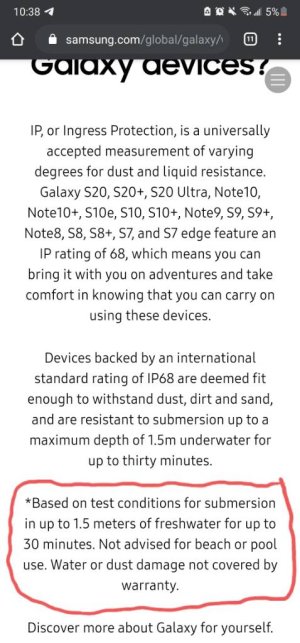
The phone can actually be submerged in up to 1.5 meters of (preferably, fresh NOT salt) water for up to 30 minutes! I would NOT TRY it however... your phone is worth too much!
 
It means it's a safety net incase a accident happens , the condition it's tested is in controlled environment.
 
It means it's a safety net incase a accident happens , the condition it's tested is in controlled environment.

...yes, not dropped in the water or jostled around, just gently placed in a tank, in a lab at a specific pressure and temperature, so when you send your failed unit back, they deny the warranty because YOU OBVIOUSLY did something wrong!!!
 
...yes, not dropped in the water or jostled around, just gently placed in a tank, in a lab at a specific pressure and temperature, so when you send your failed unit back, they deny the warranty because YOU OBVIOUSLY did something wrong!!!
I know they deny any water intrusion :(
 
The phone can actually be submerged in up to 1.5 meters of (preferably, fresh NOT salt) water for up to 30 minutes! I would NOT TRY it however... your phone is worth too much!

for instance,my hand is wet and i press the power button.Will water enter the phone?
 
for instance,my hand is wet and i press the power button.Will water enter the phone?
You can press the buttons while the phone is submerged. One of the first things I do when I get an IP68 phone is to submerge it for several minutes, carefully documenting the whole process by video, so I can return the device immediately if the advertised IP68 protection is deficient.
 
You can press the buttons while the phone is submerged. One of the first things I do when I get an IP68 phone is to submerge it for several minutes, carefully documenting the whole process by video, so I can return the device immediately if the advertised IP68 protection is deficient.

In Indonesia... If i do that and the device fails... Warranty is voided...
 
So for users does it mean by normal usage water/dust wouldnt be getting into the phone? As in by using the physical buttons water/dust wouldn't be entering the phone?

As already mentioned, the IP rating only applies to specific lab controlled tests, not the real world and all of its additional variables. Also noted the lack of any warranty coverage for water damage.

So for users, that basically means the rating is little more than a marketing gimmick, and you should treat your phone as if it's not rated unless you are prepared to pay the full replacement cost after dunking it.
 
I take my Note20 in the shower with me. Use it to listen to music. It's gets splashed and wet, i dry it afterwards. Haven't had any issues.
 
You can press the buttons while the phone is submerged. One of the first things I do when I get an IP68 phone is to submerge it for several minutes, carefully documenting the whole process by video, so I can return the device immediately if the advertised IP68 protection is deficient.

Wouldn't get a replacement in America, it's made clear the warranty doesn't cover water damage.
 
The phone can actually be submerged in up to 1.5 meters of (preferably, fresh NOT salt) water for up to 30 minutes! I would NOT TRY it however... your phone is worth too much!

Agreed. It's all good in theory, but I'd never want to test that out for myself! And you bring up a very good point about saltwater. I'll add showers to that list of no-nos, as well. Steam is not a friend to a phone, even if it's IP 68-rated!
 
Wouldn't get a replacement in America, it's made clear the warranty doesn't cover water damage.
Returning a defective product during the initial 14-day period isn't the same as warranty service. Plus I don't believe the stated warranty exclusion is legal. If a company advertises a product as having a particular capability, they are required to take responsibility if it does not.
 
Plus I don't believe the stated warranty exclusion is legal. If a company advertises a product as having a particular capability, they are required to take responsibility if it does not.

If you can prove the device failed under the same conditions as the test, you may have a case, but don't be surprised if they still try to deny it due to the specific warranty exclusion. Even looking at it under the best case scenario, that isn't how a device is going to fail at water damage. It's going to fail due to environmental contaminates, drops breaking the seals, steam getting past the seals, etc. All of those fall OUTSIDE the testing parameters, which is why it would legal to deny a water damage claim. The real world isn't a laboratory, and too many variables are involved to test against all of them.
 
If you can prove the device failed under the same conditions as the test, you may have a case
Yup, that's why I video the whole process. My goal is simply to find out right away, during the return period, under controlled and documented conditions, if there's a gross defect in the IP68 seal. So far, I've never encountered any problems.